blog

sorry i love you by brendan mcdougall

Here are some thoughts from our upcoming dinner and a show writer Brendan McDougall on his new play Sorry I Love You.

G’day reader!

I’m Brendan and I’m trying to write this play called ‘Sorry I Love You’. I’m pretty garbage at writing about my own writing, and I’m still trying to work out whether this is a methodological weakness or strength.

I started the thing early last year when I’d just returned from overseas and had lost my driver’s license and thus job. I was pretty fucking unhappy, but it did mean that I found myself with more time with those of my friends who were also pretty unhappy, and we’d all drink too much together. A couple of these unhappy people were being made unhappy, at least in my eyes, by those in their lives that they loved the most – partners of two, three, four years.

I found myself a confidante on a knife’s edge – trying to be a supportive mate, someone who listened without judgement or anger to way too many stories of emotional abuse, gaslighting, and threats of violence; while also being someone who could steer people I cared about away from harm. We’d be at once trying to make them feel safe and loved in order to give them strength to make decisions about the situation they were in, while also wanting to take away their ability to choose – because they kept choosing things that were putting them in danger – and to get them the fuck out of there. We moved their stuff out of the house, only to have it all moved back in less than a week later. What could you do – they were in love.

The play became for me an attempt to dramatise this knife-edge – the mechanics of the entrapments of love, and the contradictions in caring for someone who, in their love for another, is in danger. I was also frustrated by the way so many narratives that contained domestic abuse seemed to characterise the perpetrator as just some lizardy monster. For me, the real monstrosity of the way people can be violent towards the people they love, lies in the fact that these (most of the time) men aren’t really monsters at all, but normal dudes in other contexts. The normalcy of the perpetrators of violence is what terrifies me – the way this violence seems to be engendered, somehow, in the way Australian men are told how to be men. The ubiquity in our culture of women rendered as objects vs men being defined by their possessions lies somewhere at the heart of the thing, and that’s more terrifying to me than the idea that some men are just born wrong in the head. Like all violence too, the root cause is intersectional – all mixed up in our inability as a social unit to deal with difference across categories of race, class and sexuality. A body on the street is just a body before it is encoded by its identity signifiers, and a body on the street is there because something in our society has made someone see that body as nothing but a body – an object containing a life that may be simply taken.

The above idea is pretty convoluted, and the whole thing gets big and complicated and confused fast and this bigness and complicatedness is why the first draft of the play failed, and why I chickened out for a year on trying to fix it. The attempted unpicking of the intersections overwhelmed it and me, and the play became a litany of checked boxes and nodded heads to identity politics, and in doing so lost what makes plays plays – the real-lifeyness of it. All this covering my ass meant that I let all my intended targets off the hook. The ass-covering is also because I was really frightened about being a straight white dude writing about violence against women, and all the connotations of stealing and profiting from stories from survivors, something I really don’t want to do. But it’s been irking me, as though I’d given up on something I cared about for reasons that were more about me than about the people I wanted to write for, so I’m returning to it as an exercise in empathy. It’s a hot mess at the moment, but my mum always told me that if I cleaned my shit, I’d be more likely to find what I’m looking for, and she has this uncanny ability to be right, years after I should’ve listened the bloody first time.

Thanks to VIMH for the opportunity. Looking forward to meeting you.

Brendan

Brendan is a Melbourne-based playwright and theatre-maker. He is currently finishing up his Masters in Writing for Perfomance at the VCA. He co-founded Periscope Productions in 2012, and has been involved in all of their shows since, first as a performer, then as a director. He likes to eat oranges in the shower, and directed Lally Katz’s Apocalypse Bear Trilogy in 2016 and co-directed their 2017 production of Fire Place, a double-bill of Caryl Churchill’s A Number and Harold Pinter’s A Kind of Alaska.

wonder women by hayley lawson-smith

we can do it

Our sixth D + S writer Hayley Lawson-Smith reflects on the Wonder Woman zeitgeist ahead of her session with us on her new work Fly.

Strong women don’t come from other planets.

Okay, to be honest, I had to Google the backstory of Wonder Woman to double-check where on earth, (if it was earth?), she came from, and I sincerely apologise for the lovers of this fictional heroine for perverting the canon.

I then Googled ‘Wonder Woman imperfections’, which of course showed me reviews of the most recent film, but a little scrolling down and there we were discussing Wonder Woman’s thighs.

Wonder Thighs.

Like any writer trying to earn their salt and be worth it, (because we’re worth it), I want to be able to write SFCs.

Scary Fearsome Chicks.

Strong Female Characters.

An SFC is a fictional character who – and I only say fictional because the word ‘character’ to me implies they’re a name on a page – takes no nonsense stands up for herself stands up for others can throw a punch can smash through glass ceilings can fight inequality does not take issues lightly does fight the patriarchy is a WONDER WOMAN!

Ching ching.

(That’s the sound of her kick-arse bracelets deflecting attacks).

The SFC does not, it seems, ask permission second-guess herself ever lose argue back make poor choices exploit her sistas insult her sistas ever fail.

Or does she?

Personally, I think the shallow SFC could be counteractive to writing complicated and fallible characters who are strong because they either live with their weaknesses or fumble, stumble and bash their way through their imperfections.

And I’m pleased to say I’ve seen some examples of the FFC in recent times.

The Fucked-up Funny Chick.

The Faulty Female Character.

Complexity is hard. (I whine). A carefully crafted and layered character is not two dimensional. We’ve moved past the days of the melodrama in which the Villain twirls is awesome moustache while the Damsel kicks weakly as he ties her to the train tracks.

The Hero flexes his muscles and everything is right in the end.

We’re now aiming to create fictional women who can take care of themselves, who can survive without no man and who reflect actual real human women.

So what worried me was this trend in the focus on the SFC who presumably had no faults.

Because that simply doesn’t reflect humanity.

Or hu-womanity.

TBH, it also worried me because I just didn’t think I was up to it. Ultimately, writing a SFC in one of my plays would lead me to writing a woman more powerful than her creator, and I just didn’t want that kind of Frankenstein-esque issue on my hands, thank you very much Mary Shelley who just so happens to have been a woman and maybe even a strong one.

But I need not worry. A little scratching at the surface and we see proof that not all SFCs are without fault, not all of them are simply perfection personified.

The best Strong Female Characters are also Faulty Female Characters

As an example, I would like to talk about Merida from the most excellent Disney movie Brave and compare her to Elsa from the movie I don’t think I even have to name because #LetItGo.

Yeah, please really, let’s let it go.

Essentially, Princess Merida has a massive fight with her Mum The Queen because her Mum The Queen wants her to get married to Random Prince Guy so that the various Not Real Kingdoms In Scotland will be all peaceful and loving.

Mum Queen’s intentions are fairly honourable, and when we realise that she was most likely taught by her own mother and eventually married off to King Fergus it’s pretty easy to sympathise with her. On the other hand, you’d have to be a complete expletive deleted to not be able to see Merida’s point of view.

So it’s only understandable that the Wilful Teenager Princess barely hesitates when offered a Mysterious Unnamed Spell by a Random Witch which is supposed to change her Mum The Queen’s Mind, thereby cancelling the Competition of Who Gets to Marry Merida.

I love that Merida does this. I love that she’s all like, ‘I don’t know what this potion does but I’m an angry young woman and I’m going to do this thing and not think about the fact that it might kill me mam.’

I love how we see the vulnerability of both these Female Characters and that to find a happy ending they’re forced to go on a quest through the woods together.

It’s a heroine’s journey with minimal male influence.

Virtually no MIs.

The Let It Go movie though?

We have one FFC who is essentially punished for loving a man by being locked in a room by said man and left alone to die.

We have a SFC whose only foible seems to be the fact she can’t control her unexplained magical powers. Except she does leave an entire Kingdom to freeze to death, but that’s okay because we’re celebrating her newfound emancipation and freedom to create living snowmen in an icy wasteland, so you go girl.

And therein lies the problem with such an SFC.

I don’t take issue with her finding herself and enjoying her own company. I’m just not sure the Let It Go movie is a great example of an empowering, feminist film. It seems too easy, somehow, to symbolise inner strength by having your protagonist literally change into a sexy outfit and letting their hair down.

Give me the awkward, oops, I just turned me mam into a bear, now I have to give her back her svelte figure all while making her understand why I was so angry in the first place and get her to see my point of view storyline any day.

A lot of writing the perfect SFC who is also a FFC is self-reflective. Making mistakes, losing the argument, not getting your chihuahua into Harvard – thanks Legally Blonde – doesn’t make us less strong, it just makes us more human.

And that’s what we should want for our fictional characters.

More humanity.

Hash tag, hu-womanity.

Ching ching.

Hayley holds a Masters of Writing for Performance from The Victorian College of the Arts. Earlier this year she was granted a Fellowship with Twelve Angry Theatre where she received professional dramaturgy from Fiona Spitzkowsky while writing a full-length script for the stage. She is a current participant in the Melbourne Theatre Company’s NEON HATCH program, and has had several short and long-form plays performed by various theatre companies around Australia and the United States. 

the ideal state by christopher bryant

Writers 2015
This is Chris.

We asked our next Arvo Tea and a Show writer Chris Bryant to reflect on the development of his play The Great Dark Spot.

I am in a definite state of confusion with this play.

You see, it wasn’t ever meant to exist. It was subsidiary to my ‘graduate work’ at NIDA; this errant Word document I’d occasionally open up and bash some words into before forgetting about it for another few weeks. My graduate play, Sneakyville, traversed America, Australia, and 50+ years of cultural history and philosophy. Accordingly, for the play that would become The Great Dark Spot I set myself some boundaries: one act, straight through. Maximum four characters. One room. (Those with keen eyes will notice, when the reading happens, that I’ve managed to stretch this last boundary as far as I could.)

It was inspired by the tutor of our philosophy

class, who one day told us that the way this generation is going, when the world ends – inevitably thanks to our own hand; through climate change or mass destruction – we won’t even be able to look at the damage caused and say “well, at least we tried.” I wasn’t sure that I agreed, but it sparked something in me regardless, and off I went. It’s a play that’s set in a post-apocalyptic world, post “at least we tried”, but quietly: without violence or destruction or Charlize Theron in a two-piece made of animal pelts.

The title of this play has likewise changed numerous times. Initially it was “ONE ROOM APOCALYPSE PLAY.docx”, and then it was “Mother” – which didn’t last long, a ham-fisted reference to the familial focus in the work and the X-Files-esque term ‘mothership’ – and then it was “The Great Dark Spot”. This last name feels correct to me, indeed came with an “aha!” moment, where two and two finally made four and everything began making sense.

With all its name changes, it has also changed form: evolving from quite a naturalistic play into an odd hybrid of storytelling, interwoven monologue, film, and physical metaphor. It’s a play set in a post-apocalyptic world, true, but this apocalypse takes a back seat to the action of the play and the characters’ internal worlds. Similarly, it evolved from being an (equally ham-fisted) play about the characters’ inaction towards climate change, to a play about the characters’ inaction towards their own lives; effected as they are by personal trauma – the macro in the whirling maelstrom of an apocalyptic scenario that is only hinted at. It’s about incredibly personal loss in the face of an immense depersonalised Loss; about feeling like you should care about something impossibly large but finding it impossible to do so because you’re still focused on something comparatively small.

When I began to write the first draft of the version you’ll see if you attend the reading, I had just been diagnosed with Post Traumatic Stress Disorder. This was at once incredibly reassuring and more than a little bit harrowing. It came with an assurance that ways in which I’d been acting and thinking had a root cause that wasn’t me, but it also carried the sobering fact that I was, capital-d, Disordered. Unsure of what to do after returning from my psychologist – this kind of diagnosis tends to put a dampener on your day – I sat down, opened up my laptop, and began to write this version of the play. It’s not about PTSD but it also very much is: my own experiences, as they so often do, inevitably colouring the work that I completed around my diagnosis and my subsequent search for meaning in trauma.

I suppose this is all an incredibly long way to say that each iteration of this play has brought it closer towards what I feel like it should be, its ‘ideal state’: during NIDA, after NIDA, after my diagnosis, after the initial VIMH reading, after the Lonely Company showing, and now this version to be read. Making the choice to pursue one particular avenue is inevitably scary, because it forces you to cut off all the other avenues you could have gone down. And this was the case with this play: I kept refusing to commit myself to any particular set of themes or way of exploring these themes, simply out fear. It’s been years since I’ve written a play that’s come from a predominantly fictional place, and adding this particular anxiety into the mix of my concerns essentially stopped me from progressing anywhere with this play.

VIMH have encouraged the play into its current form: given me a lot to think about in terms of clarifying its concept and trimming its narrative fat. Their reactions have also assured me that its offbeat humour is actually, well, humorous. They’ve inspired me to think about the physical representations of the play proper, and have quite simply encouraged me to keep going; to keep travelling down the avenues I’ve started down and to keep cutting off other avenues as I do. They have helped me to push through my anxieties in order to find a version the play I’m satisfied with; a version where I have at least some idea of what I want out of it. Without their support, this would’ve been a very different play: one sitting in the depths my hard-drive, unfinished and wasting space.

The Great Dark Spot will inevitably change once more out of the discussions that arise from this reading. But at least it now has a solid and concrete base. It knows what it is.

The Great Dark Spot will be read at La Mama on Saturday 3 June, 2pm. Buy your tickets here.

Fucked Up White Girls by Emily Sheehan

girl gang

Emily Sheehan is our fifth (where has that time gone?) dinner and a show writer and she’s shared some of her thoughts here on her new work Fucked Up White Girls.

  1. What writing have you brought to dinner and a show?

I’ve brought a new play I’ve been tapping away at between two commissions I have on this year. In many ways, this has been my ‘down time writing’, and I’ve been enjoying getting to know the characters slowly, the way I might get to know a best friend. What’s been coming out and onto the page is themes of friendship and feminism. This is probably due to the fact that in my down time I’ve also been consuming a lot of female driven content, listening to some of my favourite podcasts like Mouth Time, Girl Friday, and Two Dope Queens. I love the way these works present friendship, humour and intellectual discussion between young women writers and content creators. I think those dodgy 90s rom-coms where its all about chasing the cool dude that will fix everything, has been replaced with idolising a group of cool female BFFs (…that hopefully once I find them will fix everything.) So yeah, I’m bringing a play about a group of young women, and how they define loyalty outside of their romantic partnerships.

  1. Why is it important to you?

Being a writer is really important to me. For me, it means something to write things that depict a range of human emotion, a range of human wants and desires, a range of emotional reactions to challenging situations, and writing work that challenges traditional concepts of meaningful human relationships such as family, romantic partnerships and friendship.

As younger people are waiting longer to form long-term romantic partnerships, they’re spending more and more years turning to platonic relationships for emotional fulfillment. We can see superficial examples of this trend within the millennial zeitgeist as celebrity feminists like as Taylor Swift and Tavi Gavinson have popularized the ‘group of besties’ phenomenon with hashtags like #squadgoals, positioning female friendship in popular culture as equally as important as romantic attachment. But is this translating to the depiction of meaningful platonic friendships in women’s stories? Unfortunately, no. Many female friendships depicted in popular content is still male-centric.

The title of the play, Fucked Up White Girls, is a nod to the media’s criticism of creative work made by millennial women. Often criticized for being a product of white washed, millennial privilege, HBO’s television show Girls for example, is so often slammed by critics for depicting narcissistic, selfish, young women in their mid-twenties. So often, attempts at commercially successful, populist content made by young women is quickly dismissed as narcissistic, entitled, naval-gazing. The same criticisms is not made of other similar self-reflective naval gazing of men’s comedy such as Louis C.K’s Louis, or Larry David’s Seinfeld. Or perhaps more comparable in style, Josh Thomas’s Please Like Me, a beautiful television show created by a young man in his twenties, which covers very similar subject matter, and is quite often compared to Girls, but Josh Thomas’s writing is described by critics as nuanced, sensitive and melancholic.

To the show’s credit, Lena Dunham’s writing in Girls subtly critiques generational privilege, while still honoring the humanity of its characters. And I think this quality is key, that to move forward in representation, it’s important to admit our humanity over our superiority, even if this means risking that our characters fall short of portraying the perfect feminist role model (if there even is such a thing)

  1. If you could have dinner with any artist (living or dead), who would it be and what would you ask them?

Abbi Jacobson and Ilana Glazer – obviously feminist heroes.

Or Tim Burton… I remember watching a documentary aggggges ago, maybe 10 years ago, where he said, and I’m probably paraphrasing wrong, that Edward Scissor Hands (my absolute favourite movie as a kid alongside ET, Mermaids and Drop Dead Fred) was a way to write about intimacy. He had an idea of a character that was an outsider who was afraid of intimacy, though longed to be close, and longed for touch and human connection, but because of the sharpness to his physicality he wasn’t able. And that really stayed with me. Probably because it was the first time I’d really deeply considered metaphor within work that wasn’t overly moralistic or didactic.

His work always has that darker, magical element to it, which really speaks to me. I like the idea that we can make magical our insecurities and shortcomings. The quest for perfection is ridiculous. I like that he’s able to breathe joy and life into seemingly troubled and flawed people.

Emily Sheehan is a playwright and dramaturg. Emily completed her Masters in Playwriting at the Victoria College of Arts (VCA) in 2015 where and her Bachelor of Arts (Acting) in 2011. Her first play Hell’s Canyon won the Rodney Seaborn Award, was shortlisted for the Patrick White Award, and was a showcased play in Playwriting Australia’s 2016 National Play Festival at The Malthouse Theatre. Emily is currently under commission with two companies, writing a new play “Daisy Moon Was Born This Way” for Q Theatre, and “Versions of Us”, a co-created play with Katie Cawthorne for Canberra Youth Theatre.

As a dramaturg, Emily undertook the Playwriting Australia Dramaturgy Internships in 2014, a six-month traineeship in script assessment and new play development. She has worked as a reader and script assessor for Playwriting Australia, and as a dramaturgy intern on MTC Cybec Electric, and the National Script Workshops.

BARON バロン by Eric Gardiner

Eric Gardiner is our fourth dinner and a show writer. He will be sharing a selection of scenes from and research about his new play BARON バロン, and has shared some thoughts about the unfolding process with us here.

I’m bringing a series of scenes from an unfinished play called BARON バロン. It’s still in a very early place, but there’s a few useful things I can tell you. It’s about young men and it’s about acceleration, and within that there are many ideas; everything from medieval fight clubs and airport chaplains to Little Athletics.

QandA1

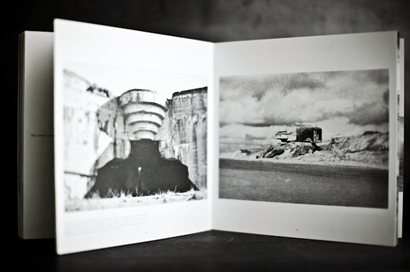
The work draws on a lot of research, particularly into the intersection between architecture and warfare. Something I’m fascinated by is the notion of “training cities” such as Baladia in Israel, an enormous simulacrum of a Middle Eastern city where they rehearse combat (The picture above comes from the Broomberg/Chanarin series of photos of that “city”, also known as Chicago). Thomas Stubblefield’s book 9/11 and the Visual Culture of Disaster made a big impression on me, and Paul Virilio’s book Bunker Archaeology (pictured below) was a great influence on the work as well.

QandA2

All of this is very interesting, but it doesn’t matter. As the work progresses that research might leave behind its residue in the play but it has to become superseded by the text’s dramatic action. So I’m hoping to use the opportunity of VIMH’s dinner and a show to talk through these scenes and this material to get a better sense of its emotional heart.

The play started off as an epic, impersonal narrative about Barron Trump, the President’s ten-year-old son.

QandA3

Look at his little face! His Mum used to smear caviar moisturiser all over his body – how could you not write about him?

(Aside: there’s a debate about whether kids like Barron should be “off limits.” I don’t find this very compelling. In my play Bounty all of the Queensland Premier’s family kept their real names as characters. In that instance I thought if I was writing about demonisation then I’d better be willing to do the same. I think sometimes the writing has to become complicit in the dynamic it’s describing – not problematic, but problematised.)

He was the seed. But I didn’t want to get bogged down in literal detail, or rehash what I’d done before with Bounty, something that relied on collage and incorporating verbatim text.

So that character shifted and became something very different. And shifting that character into this much more central position of authority allowed the rest of the work to coalesce around them, to allow for material that was much, much more personal, which could play off that central spine.

I know a lot of young men of my generation who feel aimless and worthless. They might be unemployed but they can just as easily be in full-time work that is destroying them. And there are others – some of the most brilliant, creative people I grew up with – who are successful, who work as consultants or as bankers, who are able to reconcile themselves to the dreams they’ve forsaken, and they carry themselves like invertebrates, like the dark blue suit’s a carapace, like it’s the only thing holding them together. And the world is only getting faster. I want to write about these young men, that’s why this play is important to me.

Eric Gardiner is a playwright and producer from Melbourne. In 2015 Eric was longlisted for the Scribe Prize, awarded to the best writers of nonfiction under 30 in Australia, and received first class honours from The University of Melbourne for a thesis on Australian adaptation theatre. His first full-length play, Bounty, premiered at the 2015 Melbourne Fringe, presented by Darebin Arts Speakeasy/MKA and directed by Tom Gutteridge. He is currently a playwright in residence with Lonely Company, producing Lally Katz’s Frankenstein at Theatre Works, and studying a Masters of Writing for Performance at the Victorian College of the Arts.