blog

what do you say to death?

collingwood

Fifteen days ago my uncle died.

He was in a car accident and his chest collapsed. For reasons still unknown, they could not operate as his blood would not clot and he was dead within 24 hours.

All I could feel was a sense of total absence.

The man that I had only really started getting to know halfway through last year no longer existed.

He was a real outback kind of guy.

Hard in a no-bullshit, rock-climber, mine-manager kind of way.

He’d been bitten by snakes so many times he was immune to anti-venom.

He was a diehard Collingwood fan.

He didn’t eat vegetables.

He was a serious smoker.

He was a gentle giant who in his retirement lived on Mount Tambourine with his partner, my aunty.

He worked on their massive back yard, building a rock-climbing wall in his shed, a big birdcage for their zebra finches, and a pen for their chooks.

He drove my sister and I the hour-and-a-half trip to the Gold Coast airport after our stay with them.

He called my aunty ‘Poss’.

When I heard that he’d died all I could think about was my aunty. He was her everything. They’d never had kids and had lived all over Australia, following John’s mining placements. And he was gone. A whole had been ripped into halves.

I only have a shadowy understanding of grief. My grandfather, my idol, died in 2006, and I still think about him everyday. But it was with John that I began to sense the shock of sudden death, of having your ribcage yanked out and being told that it no longer belongs to you.

The thing that I am ashamed of and which fills me with wonder is how quickly the world reasserts itself. The shock knocks out your focus, holding you in the merciless grip of remembered images, remembered words. But almost instantly your focus starts to shift back: objects refill with colour and weight, something makes you laugh, you have a conversation with someone who doesn’t know what’s happened and who you decide shouldn’t be dragged down with the details.

I’ve realised that language has not been designed to cope with death. The sheer nature of it is a ‘filling-up’; you fill up space with words, often to avoid the yawning, threatening, exhilirating emptiness of silence.

Is this why we flounder with the bereaved? What language could approximate their loss, could capture the absence of their other half?

Perhaps this is where our bodies really do come into their own. Language fails in the face of death. But you still want, desperately, to help the one left behind, to help them start stitching up the one half left. And so you hold them. A hand on the shoulder, back, knee. A hug. An encouraging, useless smile. Open arms.

What else can you do?

Funnily enough, I think one man has managed to capture grief with words, which my aunty put on the funeral service sheet:

Stop all the clocks, cut off the telephone,
Prevent the dog from barking with a juicy bone,
Silence the pianos and with muffled drum
Bring out the coffin, let the mourners come.

Let aeroplanes circle moaning overhead
Scribbling on the sky the message He Is Dead,
Put crepe bows round the white necks of the public doves,
Let the traffic policemen wear black cotton gloves.

He was my North, my South, my East and West,
My working week and my Sunday rest,
My noon, my midnight, my talk, my song;
I thought that love would last for ever: I was wrong.

The stars are not wanted now: put out every one;
Pack up the moon and dismantle the sun;
Pour away the ocean and sweep up the wood.
For nothing now can ever come to any good.

W.H.Auden
saturday night

If I ever have to define an adventure for somebody I’m going to explain what happened last Saturday night.
We were meant to be seeing a play. Decided not to. Had drinks instead on William St in an empty pub save for the tennis blaring on the platinum TV screens and a couple waiting for Godot (one of these men found Federer incredibly frustrating and worked it out by swearing at his bowl of nuts). This pub was remarkable only for the number of sneaky hidden steps (like the constant surprise of silent letters) that filled it. I think there must have been quite a few hidden cameras for the staff to pass the time watching everybody, drunk or sober, trip up.
Dinner. Bill and Toni’s on Stanley Street. White paper tablecloth. A constant supply of orange cordial. A schnitzel on a plate (just a schnitzel, save for the over-steamed carrot sticks trying to kamakaze off the side). ‘Salad’: chopped up iceberg lettuce. An unashamed/beautiful bowl of tomato sauce.
Move to the footpath outside with beers.
Move across the street to The Hazy Rose. Perhaps one of the coolest bars I’ve ever been in, but without the hipster-intimidation of most. On special, fresh summer fruit juiced in front of you with your favourite liquor. Cue frothy pineapple and rum. Cue The Clash’s London Calling. Cue Chuck Berry’s ‘You Never Can Tell’ and Pulp-Fiction-dancing. Cue overwhelming joy.
Midnight strikes. Bar closes. Head towards Town Hall to catch the bus home.
Wait a second. There are people in Hyde Park having fun. Let’s go look. 1.5 minutes later and we’ve joined the Sydney Festival Up Late crowd. Try to follow another girl who we think has found a way to sneak into the Spiegeltent. End up in the disabled toilet with said girl. Partake in the confusing sparkling/regular water tap system. Watch a group of girls dancing in a circle. The one guy in their party walks away and they immediately disband. Watch the beauty of people dancing by themselves. Watch the tables and tables of carefully made mess – hair, clothes, mannerisms. Smile at the Festival staff, all who are incredibly friendly and dressed in bracers.
Leave again for bus. Walk past woman (with a partly shaved head and dreadlocks on the rest, swept up in a bun. It was like a tsunami of hair) and man smoking weed just outside Festival barrier, staring at the trees.
Abandon bus – plan to aim for Circular Quay, for water. Walk through Pitt St Mall, drinking beer. A French man approaches, asks for a swig so he can wash down the pill he’s just swallowed. Start talking to him and his friend, both who seem to be caricatures of attractive Parisian males. Start walking with them towards a hard-dub-deep-bass-something club around the corner. Stand for a bit as they finish their cigarattes.
The one I talk to – Mr Pill – has an exquisitely trimmed beard and a cap that seems a very real extension of his face. He talks to me about the danger of growing up in the outer suburbs of Paris. About how his cousin is a drug dealer who’s learnt the magic rule – don’t take your own product and you’ll make a whole bunch of money. Also, when dope-heads come at you, you’ll have a clear head and know whether it’s a good idea to knife them or not. This man I was talking to is never bothered by anybody – I think the cousin’s knifing skills might stretch beyond dope fiends.
Walk down into the belly of a building. Music ripples towards us like a heat wave. We find out it’s $25 each to get in and quickly pivot back up the stairs, abandoning our French men to the darkness.
Start off towards the harbour again. Pass a pair of abondoned trousers – someone decided they could do without – and a surprising number of abandoned girls with heels bigger than their skirts.
Walk past The Ivy. Everyone standing outside, security and patrons alike, looks hard and mean. Neon dresses. Hair-gel that could cut like a knife. Tightened muscles under tight shirts.
Make it to the Quay. Sit on a bench and look at the watery Harbour Bridge and its solid cousin, the dancer and the drugdealer. There are a surprising amount of people that walk around at 2am.
Go to some pub to pee. This one also has a tricky front step. Play a game at the bar – pretend we’re strangers and we’re trying to pick each other up except each line we use has to be more outrageous than the last. First person to laugh loses.
Go and wait for our bus.
Invest in some McDonald’s chips. Only two people are working and they’re handwriting orders. Suddenly a mile-long queue is behind us and there’s one guy at a table with a mountain of burgers, laughing at all the hungry people.
Go and wait for our bus, again.
Get on.
Go home.
It’s 4am when we find our pillows.

Lesson: aim to catch the last bus.

muscled love

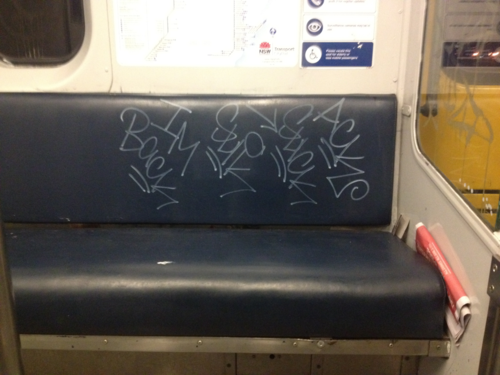
trainOn NYE I caught the train from St Peters in to Town Hall at about ten in the evening. Flynn and I got into the end carriage and sat down on the same bench as two burly, mean-looking blokes. Of course, I was immediately forced to eat my own prejudice, for the moment we sat down the man next to us introduced both himself and his friend to Flynn, asking him what our plans were for the night. I didn’t catch their names. The man closest to us was missing some teeth. I could not focus on the conversation he was having with his mate as I couldn’t tear my eyes away from the couple sitting opposite us, who were clearly travelling with these two.

He was swaying in a two second lag behind the train. His head drooped like it was too much weight for his neck to bear – almost like heroin-dropsy. He was very tall, angular; the kind of skinny where the absence of fat lets you see the inner workings of the body, like looking through a glass-bottom boat. All the veins, tendons, beating pulse-points, much of which was covered with a full spectrum of inky tattoos. He was bald, or very closely shaved. Shorts, white singlet, longish white socks falling down, sneakers.

With him was a woman I don’t think I will ever forget. She was biggish and wore short denim shorts and a tight pale pastel green singlet. She had thongs on. Her hair has stayed with me the most. I think it must have originally been blonde and she’d died it dark. Her light roots left the impression that her hairline was receding.

She loved this man. He was clearly coming down with something. I offered her my water for him but she politely declined. He tried a swig of lemon ruski instead, which she balanced delicately underneath her seat and in one smooth motion forced him to lie his head in her lap, his feet lifted above him against the carriage wall (this on the advice of our toothless friend). She had fake fingernails, which I watched as she soothed him.

Once he closed his eyes she joined in the conversation with the other blokes. A name was mentioned by one of them, to which she quickly fired

“What do you think of him?”
“Yeah, he’s a bit of a scumbag. Why? Do you know him?”
“He’s the father of my daughter.”
“Oh, well…”
“No, I think he’s a scumbag too. I should know. He slapped me around for four years.”

Now, my memory has failed me here. She did not say slapped but said instead a word that took my breath away. With this one exchange, and with the man she held in her arms, her life was filling the carriage like gas, a train-shaped snapshot of muscled love and survival.

I wish that I’d heard her name.

rian

RianI went and saw Rian last night for Sydney Festival.

“Joyous and exhilarating, the latest creation from Irish dance company Fabulous Beast is a thrilling evening of music and dance.

For this internationally acclaimed work, director and choreographer Michael Keegan-Dolan collaborates with composer Liam Ó Maonlaí of Hothouse Flowers, drawing inspiration from Ó Maonlaí’s 2005 solo album Rian (‘mark’ or ‘trace’  in Gaelic).

In a dynamic celebration of Ireland’s roots and traditions, Celtic sounds are mixed with elements of West African music, as eight dancers  from around the world unite with  five of Ireland’s top musicians.

There is reverie and release as the music propels the dancers across the stage, empowering them to make their mark.”

I have no words. Last night, I finally realised my failure in being able to express myself only through language.

What I saw on stage was magic. Not kitsch-card-trick magic. Real magic. Real Gaelic magic.

The music made my bones vanish.

And the dancers. One vignette may suffice: a skinny woman in a green shift with short hair, rolling her body through the air like her joints were ball-bearings. And she smoked a cigarette the whole time.