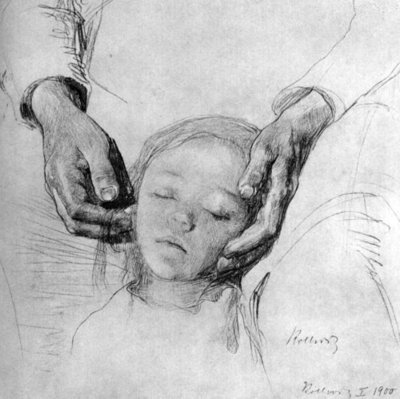
in the hands of the mother

What if emotional trauma was transferred intergenerationally by physical scarring?

Imagine: a parent is traumatised in some way, be it through war, domestic violence, racial persecution, etc. This trauma, rather than having an intergenerational trickle effect (where the fear/anger/isolation of the parent is transferred in some diluted form to the child) it would only manifest as scar tissue on the body of the child with no emotional residue (which I imagine would feel, if rubbed between your fingers, like resin. In my mind, fear is sticky.)

This recalls, in some sense, that article I wrote about a while ago, which explored the phenomenon of descendants of Auschwitz survivors having the survivors’ tattoos inked on their own skin. Although this is voluntary on the part of the descendant as a testament to the survival of their relative, it echoes this idea of a physical manifestation of past experience. Imagine if this was a way that we could read a person’s history.

We could literally read it on their body. Like in Toni Morrison’s Beloved, where the main character’s back is covered with a cherry blossom tree (which you come to realise is the latticework of scar s left from when she was a slave), we could read struggle, and past struggle, on skin. I could take your hand, or left shoulder, or elbow-bend and run my fingers over the lines of thick dense tissue and ask you what’s happened to your family.

This sketch is by Kathe Kollwitz and is called Kopf eines Kindes in den Händen der Mutter or Head of a child in the hands of the mother. It was this that set my braining running on this question. Imagine if we could suspend the pain of survival and replace it with scar tissue. But wouldn’t we want to feel the pain of the struggle that it took for our parents and our grandparents to survive? Otherwise we’d risk slipping back into the ease of invincibility. But surely our scars would also pay testament. Maybe the concerted rejection of apathy is enough.
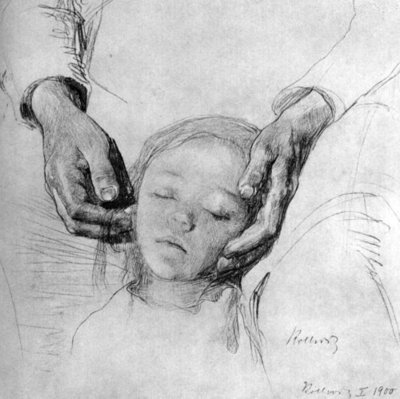
Kathe Kollwitz, Kopf eines Kindes in den Händen der Mutter

Dante in a porn shop.

Dante in a porn shop.

I went backpacking at the end of the year before last and am still showered, every day, with memories than run deeper than veins.

One that just shook me, which had not popped up for a long time, was of when I accidentally walked into a porn shop in east London and somehow ended up chatting to the store owner, trying to excuse myself from having a cup of tea with her as politely as possible.

Quickly followed by that was the memory of this painting (William-Adolphe Bouguereau, Dante and Virgil in Hell), which I had never seen until I was standing before it in the Musee D’Orsay. I couldn’t take my eyes from it for what felt like hours.

A porn shop and a painting.

The awkward and the sublime.

smashed mirror

What would happen if reflections did not exist?

Imagine it.

No mirrors, no shop windows, no reflective surfaces at all to catch yourself in.

Catching the train, you would not have your image thrown back to you by the carriage doors as you pass through a tunnel.

You would not be able to tell how far your pesky melanin had made your freckles spread.

You would not be able to look at your reflection and imagine what you would look like as a mannequin.

How would we conceive of ourselves if we couldn’t see a comprehensive whole shone back to us?

Consider the following:

“The idea of the “mirror stage” is an important early component in Lacan’s critical reinterpretation of the work of Freud. Drawing on work in physiology and animal psychology, Lacan proposes that human infants pass through a stage in which an external image of the body (reflected in a mirror, or represented to the infant through the mother or primary caregiver) produces a psychic response that gives rise to the mental representation of an “I”. The infant identifies with the image, which serves as a gestalt of the infant’s emerging perceptions of selfhood, but because the image of a unified body does not correspond with the underdeveloped infant’s physical vulnerability and weakness, this imago is established as an Ideal-I toward which the subject will perpetually strive throughout his or her life.” (Taken from here.)

As infants, we see the whole but do not feel it. We see ourselves in a mirror and it is from this that we believe that we are a single ‘whole’ self.

But the lack of control we experience our own body, this fractioning of self, does not correspond with this sense of a unified self and thus begins the striving for an unattainable ideal: reconciling our fragmentation (which more often than not feels like a glass that’s been smashed by a hammer) with the single body we see reflected in the train door.

So, what if mirrors never existed?

What if we were only ever stuck with our fragmentation?

Is this the experience of blindness? Are blind people able to deal with their multiplicity of self without being haunted by this unattainable ideal of wholeness?

Imagine that.

Imagine not struggling with the fact that you feel like Frankenstein’s monster, your roles (whether to be the student, the daughter, the lover, the musician, the doctor, the poet, from one minute to the next) sewn together like mismatched limbs, but look like a complete human being, sans stitches.

If there were no reflections, how would we conceive of ourselves? Would we find another way to create an unbridgeable gap between what we are and what we desire to be?

Inevitably, I think.

But how would it manifest if the mirror was taken away?

Lilias and P.B.

I’ve been spending an inordinate amount of time in a single space recently: the foyer of Griffin Theatre in Darlinghurst. I’ve been filling in some bouncer shifts (not in any serious muscular sense, we just can’t let glass out on to the street or neighbours/council will get mad).

As my job is to watch that people don’t drink outside, which is definitely up the easy end of a easy-hard job continuum, people-watching is inevitable. And I witnessed, on Wednesday night, one particular clash of lifestyles that I haven’t been able to get out of my mind.

Standing right in front of me was a North Shore quartet, all robust 50-somethings, dressed in shades of brown, white, and navy. The men stroked the biceps of the women when they were making a point and the women had that vitality that comes from rich pilates. They spoke of their friends and the holidays planned for the coming years (two friends that stood out were Lilias and P.B. I am still struggling to think of more perfect North Shore names.) I’ve been forcing myself to remember that all four of these have more than likely experienced incomparable suffering, but you could not see it in their faces.

It was almost as though someone had made a pre-play play in the foyer and asked what the polar opposite of this quartet would be, and then placed them beside each other. Spilling onto the street was the most glorious group of misfits that I have ever seen. I wasn’t able to work out who this group was run by but it was clear that it some sort of specifically designed social outing (the two women running it were wearing permanent-marker name-tags). There was an overweight woman with a brightly-stretched top, short hair, and black hoop earrings, who was trying to explain to the group what she thought the play was going to be about (“love and climate change, I think”). There were two young men wearing matching fedoras; one who must have had a twisted spine for he limped quite heavily on his right leg. The other had a very narrow, ginger face and perfectly round glasses. There was a much older man who had a tie-dyed hessian bag and walrus moustache (who happened, by sheer coincidence I think, to be wearing the same sandals as the brightly-coloured woman. These two were also both called Max, which was a favoured talking point).

My favourite, however, was the first man who arrived (maybe twenty minutes before anybody else). He had hair that I think was meant to have been peroxide blonde but was instead a light sherbert orange. It was combed out straight from a part centred down his scalp but rather than being combed over the curve of his head it just stuck out straight, like a graduation hat. He wore a fluoro pink polo shirt with denim jeans and a denim jacket. His smile was the most beautiful thing about him – it was slightly uncertain but also seemed glad, somehow. He had crooked teeth.

Think about this group next to the North Shore quartet.

boy

These last couple of weeks have been bound up in writing the final essays of my undergraduate degree and as a result the life-shots that I have witnessed have been bottled up to bursting point.

Perhaps the most heart-rending occurred a couple of weeks ago at Redfern station. I was on the Kings Cross platform, walking to a bench with my ear-phones in, when a slightish boy wandered past me in a peak cap. I think he might have said something to me through the ear-phones but I took him, to my discredit, for a lad and kept walking. Once seated, I had bent my head over some book when he wandered up to me.

I wish now that I had made more of an effort to remember him physically. The details are only an impression. It was an impression of neglect. He had acne. His face was thin and when he spoke it sounded like puberty had only let his voice drop half of the way. There was something anxious about his limbs, as though he was one of those cartoons who are surrounded by small double lines to denote frantic movement. He was completely devoid of aggression: there was no menace in the way he bore himself; it was almost as though the thought of threatening someone had never occurred to him (and if it did he would disregard it).

Of course, this impression is affected by what happened after he approached me (wouldn’t it be fascinating if we could recall our impressions moment by moment, without the retrospective colouring of memory, and explore how our prejudices develop [what it is exactly that triggers them: a peak cap or slouch, a tone of demand or smell of misfit]).

I took one of my ear-phones out just as he asked for change to catch a train home. I handed some coins over and, rather than disappear, he took a step aside to the payphone that stood next to the bench. He used the coins to make a call to his Mum.

I wrote down some grabs of this one-sided conversation.

Will I still be able to get new shoes today Mum?

Can you meet me at the station?

Can you still take me to the doctor?

What time are you meeting your friends?

OK, bye. Love you.

With that conversation any previous, rashly-concluded understanding that I had had was obliterated.

He was just a boy without enough money to call his mother.