The Hansard Monologues

Politics, etc.
Politics, etc.

Last Friday I caught the bus down to Canberra to catch Katie Pollock’s The Hansard Monologues, which was showing for two nights at Old Parliament House. I’d missed the Sydney season so my partner and I decided to make a weekend of it (we’d read somewhere that Canberra is not only the capital of Australia, but also the capital of fun).

The show, the entire experience, was utterly extraordinary.

The first thing we encountered upon entering Old Parliament House was a man sitting at a small card table with a cash box. It was not, as you might think, a makeshift box office. It was everything that is wrong with bureaucracy. The man was selling tokens. Rather than paying for your drinks and food directly, you had to pay him for tokens, which you then took to the food or drink stand.

1 token = $5.50

3 tokens = $15.00

1 token = one wine, beer, etc or TWO soft drinks

This meant a big queue for tokens, which then led onto equally long queues to actually use them.

Canberra, amiright?

This was the show’s blurb:

What will we remember about the 43rd Parliament of Australia? That it was supposed to be about us – but was it really just about them?

As the election nears, this verbatim play will take the words of Hansard, the factual record of what our MPs say in parliament, to relive the highs and lows, the `ayes’ and `nays’ of our national discourse.

In the tradition of The Vagina MonologuesThe Hansard Monologues: A Matter of Public Importance will let our MPs speak for themselves.

This is the story of how our country makes itself, over and over again. It’s about us.

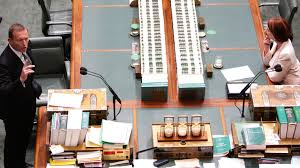
Three actors were used to represent the gamut of politicians. In a vague outline, Camilla Ah Kin played Gillard and other Labor MPs, Tony Llewellyn-Jones played Abbott and other Liberals, and David Roberts generally played the Independents (most notably Windsor and Oakeshott). As the text was drawn exclusively from Hansard the artistry of the piece was in how this raw data, this raw speech, had been curated. The team had split the play into roughly six sections, each with a different title – Sex and Scandals, Refugees, etc – and then had sewn together the most provocative moments from each subject. Heartbreakingly, the backbone connecting each section were the names of fallen Australian soldiers, which were projected onto a black screen.

It is difficult to pinpoint what was most enthralling. The actors sat in amongst us – the audience was seated in both the plush green of the floor as well as in the observer gallery. I sat next to Gillard for most of the show, and Camilla captured perfectly the ex-PM’s habit of throwing a withering glance back to her colleagues when Abbott opened his mouth. I think what might have been most astonishing were the words themselves. The vitriol and the compassion with which various speeches were made, the sense of genuine emotion versus ‘going through the motions,’ was so clear it was stunning. I ended up spending almost half the show in tears as they covered Gillard’s misogyny speech and her declaration of passing the NDIS, Penny Wong’s rejection of her daughter growing up in a ‘not-right’ family and of being less loved, and Oakeshott cutting through the hysteria of Rudd’s succession and recognising the pride Gillard’s father would have felt for her. All of these speeches that I had seen on the news or social media were suddenly being said by living bodies in a space much like where they would have been originally declared.

I have never been a part (we were literally within the work, sitting in the chairs upon which our political ancestors have sat) of a show where the space has been so deeply politicised. The actors stood where our prime ministers and their allies and foes might have stood and spoke. I was suddenly able to understand the greatest joy and the greatest burden of democracy – abnegation of social responsibility is not an option. There is nothing special about our politicians – they are there because they have been voted in as a representative of a group of people. This does not make them more than us. What Katie’s show brought to a head was the cowardice, the courage, the pettiness, and the desire to do good, to be a good person for others that is embodied by our politicians. What she showed was their humanity. What she made me understand, as the audience sat in the same chairs as these politicians would have sat in if New Parliament House had not been built, is that we are no different from them. Unlike them, we are not required to submit to such exposure, we are not required to represent others, to be good, so consistently, on such a public stage.

In the Q & A afterwards the team spoke of how they think history will treat the 43rd parliament. Obviously, the first female PM was mentioned, as well as her successful wrangling of a minority government. It was suggested that we as a country will be decried for our sexist derision of her leadership. It was also suggested that there was a very unusual amount of power wielded by the Independents. The crowd’s average age would have been 65+ but the assumptions of conservatism on my part were grossly misinformed. There was an outcry from the women in the audience about the sexism of this parliament – one woman spoke of taking part in the first feminist wave here in the sixties and the relief with which she listened to Gillard’s misogyny speech: finally, someone had said it out loud, someone had voiced a reality many of us cannot bear to face.

Perhaps the moment that took the cake was when an old man took the microphone at the end of the Q & A to reveal that he had run Hansard for 14 years before he retired. He talked of beginning under Menzies, at 22 years old. Of how a young Whitlam welcomed him on his first day on the job. I spoke to him afterwards and asked him what he thought was the most exciting time in politics in the last 40 years.

He immediately said ‘Whitlam’s dismissal. For three months you’d come to work and not know who was in power. On the day he lost John Kerr, it was absolute mayhem in here (he was talking about the very room in which we were standing). I stood on the steps as Whitlam made his final speech.’

I suddenly realised that he must have been one of those men milling in the background as Gough condemned the Governor-General. This was living, breathing history with a very neat suit and big old-man ears.

Although Canberra may be a ghost-town that’s not really built for humans (we had to get a taxi for McDonald’s drive-through, as everything closes at 10 and they discriminate against people who don’t drive) it made me realise the importance of democracy. Despite all of its flaws and foibles, it allows people to face each other and try to work out solutions to our problems. I think its brilliance might indeed lie in these very flaws. We expect our politicians to be superhuman and condemn them when they fail/fall but the reality is that they are just as human as the rest of us.

I now think of democracy as the pursuit for a mutual recognition of this humanity.
wordless verbatim

I started asking questions, recently, about ways of knowing that do not relate to objective evidence. How can you tell a person by their smell? What music arrests movement because it defies reality, cutting into something inside of you that cannot be reached with language? Could we use a piece of music to create a sense of a person that could never be achieved with words?

I am currently writing a play about my grandmother. It is a verbatim theatre piece except that I never met her and I have no record of anything that she said.

I need, then, to work out how to make a person come alive that circumvents traditional ways of knowing and I think music might be a good place to start.

Below is the ongoing list of suggestions of music that cuts into the body, reaching something that is otherwise impregnable. Any more suggestions are deeply welcome.

(I made a judicious decision to leave out Miley Cyrus’s ‘Party in The USA.’)

  1. George Gershwin – Rhapsody in Blue
  2.  Nine Simone – Feeling Good
  3. Edward Elgar – Cello Concerto in E Minor
  4. G.F. Handel – Largo (from Xerxes)
  5. Arvo Part – Cantus in Memory of Benjamin Britten
  6. Leonard Cohen – The Traitor
  7. Nick Cave – The Ship Song
  8. Nick Cave – Into My Arms
  9. Regina Spektor – Samson
  10. Albinoni – Adagio in G Minor
  11. Rufus Wainwright – Cigarettes and Chocolate Milk
  12. Wagner – Liebestod from Tristan and Isolde
  13. Samuel Barber – Adagio for Strings
  14. Barry White – Love’s Theme
  15. Yndi Halda – We Flood Empty Lakes
  16. The Beatles – Tomorrow Never Knows
  17. Tchaikovsky – Manfred Symphony
  18. John Adams – The Dharma at Big Sur
  19. John Coltrane – A Love Supreme
  20. Elgar – Nimrod (Enigma Variations)
  21. Ani DiFranco – You Had Time
  22. Purcell – When I Am Laid In Earth (Dido and Aeneas)
  23. The Beatles – Blackbird
  24. David Bowie – Quicksand
  25. Sibelius – Symphony No.5 in E Flat Major
  26. The Shins – New Slang
  27. Linda Perry and Grace Slick – Knock Me Out
  28.  Loudon Wainwright III – Carrickfergus
  29. Radiohead – No Surprises
  30. Lana Del Rey – Radio
  31. Beethoven – Symphony No. 7
  32. Camera – Break/Hands
  33. The Decemberists – January Hymn
  34. The Unthanks – Farewell Regality + Here’s The Tender Coming
  35. Schubert – The Shepherd on the Rock
  36. Vaughan Williams – The Lark Ascending
  37. The Pixies – Where Is My Mind?
  38. Joanna Newson – Jackrabbits
  39. Jarvis Cocker – Running the World
  40. Erik Satie – Gymnopedie No. 1
  41. Wang Fan – Give My Body To

come and join me

Will CrawfordA bunch of weeks have flown by since February 1 and they are a flurry of memorable moments that are more than likely couched in mundanity. This is how life goes on though, right? Sizzling along with a brief flash in the pan here and there.

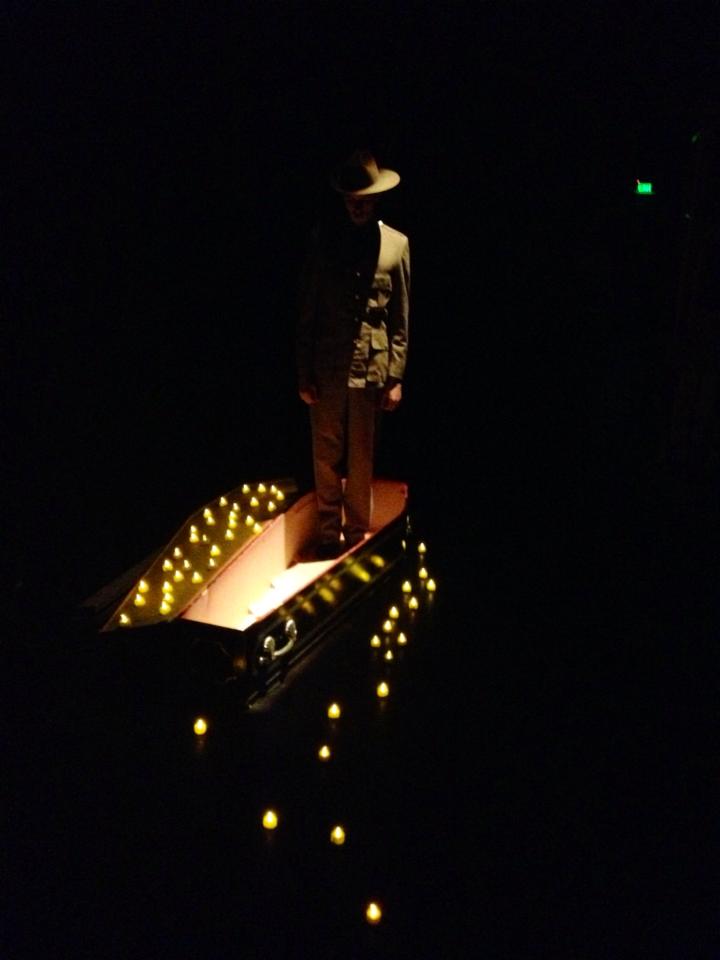
Then, every once in a while, the sublime creeps upon you, quietly. This photo is of that moment, that moment of sublime that lifted me out of the day-to-day slide

When I last wrote in this space, I was playing around with an idea that I’d pitched to Performance Space about making a short work literally inside a coffin. The idea was accepted for their Nighttime: Live and Let Die program and Lana Costa, Tom Cocquerel and I were suddenly facing a fortnight deadline to make what we’d envisaged.

This experience was utterly new to me. I’d never worked to such a tight deadline. I’d never worked, I realise now, in such a truly collaborative way. And I’d never reached the day of the performance so uncertain about whether the work would be a disaster or not. A couple of nights before the show, I experienced a very real revelation which, as is always the case with self-evident truths, I had thought I had understood but had not actually grasped until I was living it. Sleepless, wondering whether we could pull this extremely risky idea off, I got slapped in the face with this: it would either work or it wouldn’t. It was as simple as that. And with this I realised the importance of releasing myself from the desire to ‘get a hold of’ what I was making; essentially, I realised I had give up my desire for control.

Lana pitched the idea of a WWI soldier, which gave us a very strong access point for the idea of being buried with your decisions (as all soldiers given a military funeral were buried in their uniforms). Together, the three of us created a character, William Crawford: grew up in Brisbane, joined the Light Horse to see the world, trained in Egypt, fell in love with a prostitute in Cairo called Anta, injured in Gallipoli, died of infection on the boat back to Egypt, buried outside the training camp, Mena.

Seven days after he has died, he wakes up in his coffin. There is a bottle of Anta’s perfume in his breast pocket. Which means, what? That she travelled from Cairo when she heard that he was dying? That she loved him?

By the time of the performance, our conceit had evolved to this: you are buried with the smells of the most important moments in your life. It was meant to be a question, for the audience, of what they want these smells (choices) to be.

It was risky because Tom, as Will, was set to engage with the first person that he saw and start a conversation with them through which, ideally, his story could come out as an explanation to that person about the importance of making your own choices. During this conversation, it was hoped that some of the rest of the audience, who were meant to be milling around, would come up and watch this exchange.

Everything was literally out of our control. We got the coffin on the day of the show to practice in. We got that stunning lighting state an hour before it opened. At the last minute, the curator decided that the whole audience should watch our piece first rather than mill around.

So what we expected to maybe be a crowd of 20 witnessing this ended up being around 85 people sitting and standing around Tom, watching him have this conversation with a girl sitting by the foot of the coffin.

This picture that you see to the right, this show, is the closest that I’ve ever come to making onstage what I can see in my head. And there was basically nothing that I did that brought that about.

The arbitrariness of the universe, right?

Step into my coffin. I’ll show you around.

chessI’m in the thinking stages of making a show about what it might be like to wake up in your own coffin. Writer Ellana Costa and I want to look at the hard reality of ghosthood. What if you were a ghost with limits? What if you couldn’t defy gravity or boundaries but were stuck for eternity inside a wooden box?

Performance Space (a theatre company based at Carriageworks) are running a short work evening at the beginning of March called ‘Nighttime: Live and Let Die’ and to apply to be a part of it you had to pitch an idea around the themes of death, night, dreams, ghosts, rebirth, etc. Coincidentally, I saw a performance two days before the application was due in which a man dreamt that he had died and yet was awake in his coffin. The avalanche this scene set off in my head resulted in this pitch (I’ll spare you the artistic masturbation and just give you the broad outline):

“Step into my coffin. I’ll show you around.”

Tom has just woken up as a ghost. He’s in his coffin and is surrounded by objects. The only problem is, he can’t make sense of them. What is so important about that whistle? And why is there a bible underneath his pillow?

come and join me’ is about the disconnect between how we are seen by our loved ones, and how we see ourselves.

If an audience member gets close enough, Tom will ask them to step into his coffin and help him work out why he’s been buried with a bible, and why he’s wearing a Ramones T-shirt.

When we are grieving the loss of a loved one, we bury them with objects symbolising who they were to us, but perhaps not to them. What if you never told them what you loved about them? Or what if you loved the part of them that they despised?

‘come and join me’ is also about the inexplicable choices we make in life – why we choose to learn the clarinet instead of the oboe, or to be a novelist rather than a dancer. Buried with the objects that mark these choices, we are faced with an eternity of contemplation.

The possibility that I’ve now realised, which I should have put in the application, is this: what if a ghost was given a chance to explain their chest-pieces?

Chest-pieces is an idea I had a while ago that runs vaguely along these lines:

What if every sternum was a door that you could swing out to reveal the six precise memories that have had the most formative influence on a person? What if you could reach your hands inside and take them out, one by one, and roll them between your fingers? I imagine that these six memories would be concentrated, like juice, to resemble something like chess pieces that you can roll around in the palm of your hand. Imagine if you could handle the chest-pieces of another person to discover who they were, rather than trying to negotiate the said/unsaid of language (and our heinous ability to understand our own selves and then communicate that understanding) […] What if these six pieces were lined up before you the moment that you died?

The trouble we have with being alive is that our lives are spooling out like thread – this thread will continue to spool until it runs out. Obviously, this is not really a problem, but the one thing we are denied with death is a definitive line-up of those six chest-pieces, those six moments that you could place in the hands of another human to make them understand how and why you lived your life.

BUT. What if you were a ghost? You would no longer be living. Your thread would have stopped spooling. But you would have your six chest-pieces. And you’d be able to hand them to somebody and make them understand what you lived for, maybe what you died for.

I guess the challenge for Lana and I is to work out how to minimise the elephant tread of language in this imagining.

status makes me mad

I’m pretty mad right now. In fact, my blood is boiling. It’s a niche madness, though, that may skim off the skin of most people as irrelevant.Venn

All self-conscious irony aside, I am an artist. I live to aid and abet the creativity of others and to make work that sharpens perception.

There is no question about this.

The other day I was asked whether I’m a feminist or not. What? Of course I’m a feminist. If being a feminist means that you don’t question the fact that men and women are equal, then I’m a feminist. None of this nth-Wave rubbish. It’s a fact, that sits alongside the fact that I have legs and that the paint on my house is peeling.

Similarly, there’s no question about my being an artist. It’s nothing to boast about. I wake up with it and I take it to bed. It makes me self-conscious when I say it out loud, and slightly ashamed as I see ‘bum’ flash in the eyes of the person I’m talking to. But I don’t care. Yes, I make no money. Yes, the things I make can’t be put on a coffee table or improve our roads. But they do other things instead.

I imagine that this is a pretty common feeling. There is nothing lofty about my identity, nothing unique.

Which brings me to the anger: today I witnessed a status-rip, a chasm of misunderstanding so deep that I don’t know whether it can be overcome. I overheard a conversation between two extremely talented theatre practitioners who have 30+ years of experience under their collective belt. They were having a conversation about the indie theatre ‘scene’, speaking about various events that have taken place in the last year and the benefit they hold for young theatre makers.

Neither of them had been to any of these events.

By coincidence, I had been at most of these events.

And I listened to them correct each other about what had happened at each of them.

And neither of them got it remotely right.

Those who sit in the lofty clouds of recognition identify as artists in the same way as those in the dirt. We all want to change people, tell stories, develop a sense of community, etc. But we’ve lost any sort of connection between these two positions. Those in the clouds have stopped looking down.