smashed mirror

What would happen if reflections did not exist?

Imagine it.

No mirrors, no shop windows, no reflective surfaces at all to catch yourself in.

Catching the train, you would not have your image thrown back to you by the carriage doors as you pass through a tunnel.

You would not be able to tell how far your pesky melanin had made your freckles spread.

You would not be able to look at your reflection and imagine what you would look like as a mannequin.

How would we conceive of ourselves if we couldn’t see a comprehensive whole shone back to us?

Consider the following:

“The idea of the “mirror stage” is an important early component in Lacan’s critical reinterpretation of the work of Freud. Drawing on work in physiology and animal psychology, Lacan proposes that human infants pass through a stage in which an external image of the body (reflected in a mirror, or represented to the infant through the mother or primary caregiver) produces a psychic response that gives rise to the mental representation of an “I”. The infant identifies with the image, which serves as a gestalt of the infant’s emerging perceptions of selfhood, but because the image of a unified body does not correspond with the underdeveloped infant’s physical vulnerability and weakness, this imago is established as an Ideal-I toward which the subject will perpetually strive throughout his or her life.” (Taken from here.)

As infants, we see the whole but do not feel it. We see ourselves in a mirror and it is from this that we believe that we are a single ‘whole’ self.

But the lack of control we experience our own body, this fractioning of self, does not correspond with this sense of a unified self and thus begins the striving for an unattainable ideal: reconciling our fragmentation (which more often than not feels like a glass that’s been smashed by a hammer) with the single body we see reflected in the train door.

So, what if mirrors never existed?

What if we were only ever stuck with our fragmentation?

Is this the experience of blindness? Are blind people able to deal with their multiplicity of self without being haunted by this unattainable ideal of wholeness?

Imagine that.

Imagine not struggling with the fact that you feel like Frankenstein’s monster, your roles (whether to be the student, the daughter, the lover, the musician, the doctor, the poet, from one minute to the next) sewn together like mismatched limbs, but look like a complete human being, sans stitches.

If there were no reflections, how would we conceive of ourselves? Would we find another way to create an unbridgeable gap between what we are and what we desire to be?

Inevitably, I think.

But how would it manifest if the mirror was taken away?
let’s

Let’s crush pigeon-hearts
and run amuck.
Let’s rip the moon down;
let’s sew her to the ground
and slide across her face
with muddy feet.
Let’s howl at passing traffic
and lie naked in the rain,
watermarking our one double-body
on the pavement.
Let’s catch fish with our bare hands
and roast them with a lighter,
make seaweed crowns,
pass out on the sand
between giant whale-ribs
and sleep.

©LS 2012

remembrance day

My grandfather, Robert Gordon Martin, served in Darwin during WWII. He never spoke of this experience. Our only real evidence of it was his blindness, which had been induced in old age by his smoking (they gave out free cigarettes during the war). My grandmother, Mary Jean Martin, also served, although in wireless communications and not, as I thought, by delivering bomb-filled cigars to the front line of Germans on horseback.

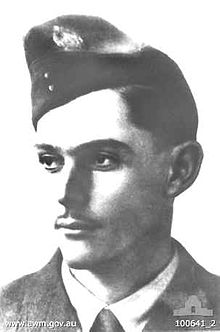
Ron Middleton, dead at the age of 26, was posthumously awarded the Victoria Cross for action in a raid on Turin, Italy.

I think Poppy’s exposure to the war, and his profound reticence about the experience, has fuelled my fascination with the way humans act when exposed to this very particular form of adversity. It not only exposes our predilection for mutual suffering and barbaric cruelty but it also shines a light on our nobility and the pure selflessness of bravery.

For a long time I have been trawling the War Memorial website, reading the stories of those soldiers who were awarded for their exceptional courage, and this morning I came across Ron Middleton, who was born a year after my grandfather and died in 1942, at the age of 26. This account has been taken from the War Memorial Victoria Cross Encyclopedia.

Rawdon Middleton was born on 22 July 1916 at Waverly in Sydney, a great-nephew of the explorer, Hamilton Hume. His family moved to the western districts of New South Wales when he was young and he attended school in Dubbo, becoming a keen sportsman and later finding work as a jackeroo.

He enlisted in the RAAF on 14 October 1940 under the Empire Air Training Scheme. Having learnt to fly at Narromine, New South Wales, Middleton was sent to Canada to continue his instruction. He reached Britain in September 1941 and was promoted to Flight Sergeant in December that year. In February 1942 Middleton was posted to 149 Squadron, Royal Air Force, and began his operational career. His first operational flights, to the Ruhr, were as second pilot in Stirling bombers but by July he had become first pilot. His first operation as captain of an aircraft was to Düsseldorf.

On 28 November 1942 he took off on his 29th operation (one short of the thirty required for completion of a ‘tour’ and mandatory rotation off combat operation) to the Fiat works in Turin, Italy. Middleton’s aircraft was struck by flak over the target, one shell exploded in the cockpit wounding Middleton in the face and destroying his right eye. The same shell also wounded the second pilot and wireless operator. Middleton lost consciousness and the aircraft dived to just 800 feet before the second pilot brought it under control. They were hit by more flak as they tried to escape the target.

When Middleton regained consciousness he began the long and gruelling flight back over the Alps towards England, knowing that his damaged aircraft had insufficient fuel to complete the journey. The crew discussed the possibility of abandoning the aircraft or trying to land in northern France but Middleton decided to head for England where his crew would have the chance to bail out. During the return flight he frequently said over the intercom “I’ll make the English Coast. I’ll get you home”. As they approached the French coast the Stirling was again hit by flak but flew on. Now over the English coast with only five minutes of fuel left Middleton ordered the crew to abandon the aircraft. Five men left the stricken plane, and two remained on board to help Middleton before attempting to parachute to safety, although unfortunately both were drowned. The Stirling then crashed into the sea, killing Middleton. He was only one operation away from completing his first tour on bombers.

Middleton’s bravery was recorded in the English press and earned him the admiration of the British public and a posthumous Victoria Cross. His body washed ashore at Dover on 1 February 1943 and he was buried in the churchyard of St. John’s, Beck’s Row, Suffolk, with full military honours.

The last line of his Victoria Cross Citation reads: “His devotion to duty in the face of overwhelming odds is unsurpassed in the annals of the Royal Air Force”.

the dancers

The floors are slippery with blood:
The world gyrates too. God is good
That while His wind blows out the light
For those who hourly die for is –
We still can dance each night.

The music has grown numb with death –
But we will suck their dying breath,
The whispered name they breathed to chance,
To swell our music, make it loud
That we may dance, – may dance.

We are the dull blind carrion-fly
That dance and batten. Though God die
Mad from the horror of the light –
The light is mad, too, flecked with blood, –
We dance, we dance, each night.

The Dancers (During a Great Battle, 1916) – Edith Sitwell