play eight: speaking in tongues

Author: Andrew Bovell

Published: 1996

Synopsis: “Two couples set out to betray their partners…

A lover returns from the past and a husband doesn’t answer the phone… A woman disappears and a neighbour is the prime suspect… Contracts are broken between intimates and powerful bonds are formed between strangers.

In Andrew Bovell’s masterfully interconnected polyphony, an evocative mystery unravels at the same time as a devastating tale of disconnection between individuals, partners and communities.” (Taken from Australian Plays, which can be accessed here.)

What moved me: what moved me is the reason I cannot choose an image for this play. It is a polyphony: a simultaneous combination of a number of parts, each forming their own melody whilst also harmonising with each other. The sensation of reading this play, or listening to this play, is of being enmeshed in a musical tapestry in which you must choose a strand for your ears to pay attention to whilst you are surrounded by the throb of the weave.

the sound of war

I’m developing an idea for a show at the moment that studies the dissonance and necessity of love during wartime. A challenge that I’ve set for myself is to focus on rhythm within the work, which I’ve previously never given much thought to. With this in mind, I’m trying to create a framework of sound within which to develop the ideas of this piece. I’m crowdsourcing this research (many minds are always better than one) in response to the question ‘What music makes you think of war?’ These have been the responses so far:

1. Edgard Varèse – Ionisation (1929–1931)

2. Krzysztof Penderecki – Threnody for the Victims of Hiroshima

3. Gustav Holst – The Planets – Mars, the Bringer of War

4. Tchaikovsky – 1812 Overture

5. Rameau – Castor et Pollux, Tristes apprets, pales flambeaux

6. Bob Dylan – All Along the Watch Tower 

7. Bruce Springsteen – Born in the USA 

8. The Black Angels – Young Men Dead 

9. The Cranberries – Zombie

10. PJ Harvey – Let England Shake

11. The Clash – Rock The Casbah

12. Albinoni – Adagio in G Minor for Strings

13. The Last Post

14. any and all bagpipes

All suggestions are welcome.

when all the others were away at mass

When all the others were away at Mass

I was all hers as we peeled potatoes.

They broke the silence, let fall one by one

Like solder weeping off the soldering iron:

Cold comforts set between us, things to share

Gleaming in a bucket of clean water.

And again let fall. Little pleasant splashes

From each other’s work would bring us to our senses.

So while the parish priest at her bedside

Went hammer and tongs at the prayers for the dying

And some were responding and some crying

I remembered her head bent towards my head,

Her breath in mine, our fluent dipping knives–

Never closer the whole rest of our lives.

– Seamus Heaney

what do you say to death?

collingwood

Fifteen days ago my uncle died.

He was in a car accident and his chest collapsed. For reasons still unknown, they could not operate as his blood would not clot and he was dead within 24 hours.

All I could feel was a sense of total absence.

The man that I had only really started getting to know halfway through last year no longer existed.

He was a real outback kind of guy.

Hard in a no-bullshit, rock-climber, mine-manager kind of way.

He’d been bitten by snakes so many times he was immune to anti-venom.

He was a diehard Collingwood fan.

He didn’t eat vegetables.

He was a serious smoker.

He was a gentle giant who in his retirement lived on Mount Tambourine with his partner, my aunty.

He worked on their massive back yard, building a rock-climbing wall in his shed, a big birdcage for their zebra finches, and a pen for their chooks.

He drove my sister and I the hour-and-a-half trip to the Gold Coast airport after our stay with them.

He called my aunty ‘Poss’.

When I heard that he’d died all I could think about was my aunty. He was her everything. They’d never had kids and had lived all over Australia, following John’s mining placements. And he was gone. A whole had been ripped into halves.

I only have a shadowy understanding of grief. My grandfather, my idol, died in 2006, and I still think about him everyday. But it was with John that I began to sense the shock of sudden death, of having your ribcage yanked out and being told that it no longer belongs to you.

The thing that I am ashamed of and which fills me with wonder is how quickly the world reasserts itself. The shock knocks out your focus, holding you in the merciless grip of remembered images, remembered words. But almost instantly your focus starts to shift back: objects refill with colour and weight, something makes you laugh, you have a conversation with someone who doesn’t know what’s happened and who you decide shouldn’t be dragged down with the details.

I’ve realised that language has not been designed to cope with death. The sheer nature of it is a ‘filling-up’; you fill up space with words, often to avoid the yawning, threatening, exhilirating emptiness of silence.

Is this why we flounder with the bereaved? What language could approximate their loss, could capture the absence of their other half?

Perhaps this is where our bodies really do come into their own. Language fails in the face of death. But you still want, desperately, to help the one left behind, to help them start stitching up the one half left. And so you hold them. A hand on the shoulder, back, knee. A hug. An encouraging, useless smile. Open arms.

What else can you do?

Funnily enough, I think one man has managed to capture grief with words, which my aunty put on the funeral service sheet:

Stop all the clocks, cut off the telephone,
Prevent the dog from barking with a juicy bone,
Silence the pianos and with muffled drum
Bring out the coffin, let the mourners come.

Let aeroplanes circle moaning overhead
Scribbling on the sky the message He Is Dead,
Put crepe bows round the white necks of the public doves,
Let the traffic policemen wear black cotton gloves.

He was my North, my South, my East and West,
My working week and my Sunday rest,
My noon, my midnight, my talk, my song;
I thought that love would last for ever: I was wrong.

The stars are not wanted now: put out every one;
Pack up the moon and dismantle the sun;
Pour away the ocean and sweep up the wood.
For nothing now can ever come to any good.

W.H.Auden

muscled love

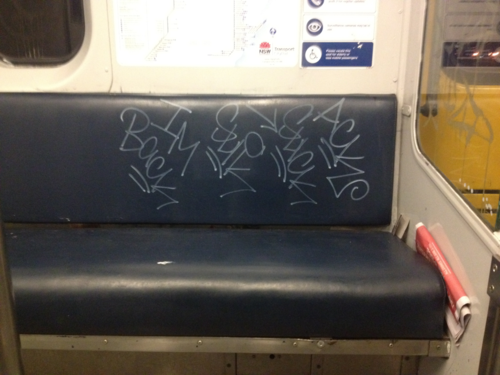
trainOn NYE I caught the train from St Peters in to Town Hall at about ten in the evening. Flynn and I got into the end carriage and sat down on the same bench as two burly, mean-looking blokes. Of course, I was immediately forced to eat my own prejudice, for the moment we sat down the man next to us introduced both himself and his friend to Flynn, asking him what our plans were for the night. I didn’t catch their names. The man closest to us was missing some teeth. I could not focus on the conversation he was having with his mate as I couldn’t tear my eyes away from the couple sitting opposite us, who were clearly travelling with these two.

He was swaying in a two second lag behind the train. His head drooped like it was too much weight for his neck to bear – almost like heroin-dropsy. He was very tall, angular; the kind of skinny where the absence of fat lets you see the inner workings of the body, like looking through a glass-bottom boat. All the veins, tendons, beating pulse-points, much of which was covered with a full spectrum of inky tattoos. He was bald, or very closely shaved. Shorts, white singlet, longish white socks falling down, sneakers.

With him was a woman I don’t think I will ever forget. She was biggish and wore short denim shorts and a tight pale pastel green singlet. She had thongs on. Her hair has stayed with me the most. I think it must have originally been blonde and she’d died it dark. Her light roots left the impression that her hairline was receding.

She loved this man. He was clearly coming down with something. I offered her my water for him but she politely declined. He tried a swig of lemon ruski instead, which she balanced delicately underneath her seat and in one smooth motion forced him to lie his head in her lap, his feet lifted above him against the carriage wall (this on the advice of our toothless friend). She had fake fingernails, which I watched as she soothed him.

Once he closed his eyes she joined in the conversation with the other blokes. A name was mentioned by one of them, to which she quickly fired

“What do you think of him?”
“Yeah, he’s a bit of a scumbag. Why? Do you know him?”
“He’s the father of my daughter.”
“Oh, well…”
“No, I think he’s a scumbag too. I should know. He slapped me around for four years.”

Now, my memory has failed me here. She did not say slapped but said instead a word that took my breath away. With this one exchange, and with the man she held in her arms, her life was filling the carriage like gas, a train-shaped snapshot of muscled love and survival.

I wish that I’d heard her name.