It’s a Sunday night and I’m walking back towards Lygon Street after seeing a friend’s show at La Mama.
There’s a double-bass player busking, still playing from when I’d been heading towards the theatre several hours earlier.
What is he playing?
Camille Saint-Saëns The Swan.
That fucker.
It is sometimes a terrible thing that sound travels. The song floats after me as I walk towards the Melbourne Uni tram stop.
–
My grandfather died when I was 15. ‘A good and gentle man’ is written on his headstone.
He was old Labor and taught at the Teachers’ College behind UTS. He had four girls with his wife Jean – Jane, Susan, my mum Anne, and Megan.
His name was Robert Gordon Martin. Bob.
He was one of those men who stopped aging at 50, with the same narrow face, long nose and combed-back hair at 90. There was always a plate of loose change on his bedside table that would be halved between my sister and I when the coins reached its lip. He ate half a paw-paw every morning for breakfast and it smelt disgusting.
I loved him.
The last time I saw him, he’d been moved to the Sacred Heart Hospice in Darlinghurst. The staff had brought his bed into the family room so we could all fit in with my cello. All his daughters were there. I played every sheet of music that I had with me. When the sheets ran out I continued to play the one piece I knew from memory; Saint-Saëns The Swan. Again and again, like a skipping record. Everyone was crying. I put my cello down and went over to his bed and he whispered ‘You’re a good girl’ in my ear.
I played at his funeral with my cello teacher Clara. A Vivaldi duet. You can still see the stains on my cello from where my tears corroded the varnish. A topography of grief.
It is rare for me to hear The Swan playing on the radio, or on a street in early spring, but if I do I have to walk away.
That music – the cello itself – is too closely knotted with his death to be untied. My ability to play has shut itself off, like a valve in my heart has gently, determinedly, refused to let blood in again. It is no great loss, I do not pretend brilliance – I did not have the skill or natural flair. But I did love to play. There were some rare moments, particularly playing Bach’s Prelude, where it felt like the wood had fused onto my sternum, or the wood and bone had vanished altogether and I was inside the sound and the sound was inside me.
It makes sense to me that we lose parts of ourselves when those we love die. The loss must stamp itself in and if it cannot do it to our bodies then it settles for the mind. We stop playing, or singing, out of respect for the person no longer with us (and because we have tied the euphoria of creating to our love for them).
Part of I sat and waited but you were gone too long examines this relationship between grief and music. The character Ellen is a songwriter but she can no longer sing for other people. The depth which music is embedded in her love for her Mum, who is now gone, is too great. The play considers the circumstances necessary for her to allow herself to sing again – for how we might extricate a sense of betrayal from our ability to create.
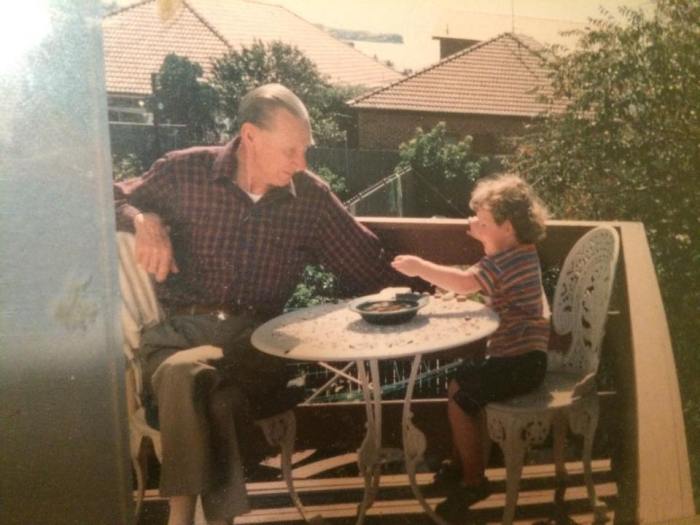
Poppy, patiently listening to me explaining my favourite rocks to him.
FEMALE FRIENDSHIP, IDENTITY, AND RACIAL SHAME IN TONI MORRISON’S SULA AND LOVE
This was the title of the English Honours thesis that I wrote in 2013, which has provided the foundation for the relationship between Woman and Girl in I sat and waited but you were gone too long.
The Nobel Prize in Literature for 1993 was awarded to Toni Morrison “who in novels characterised by visionary force and poetic import, gives life to an essential aspect of American reality”. This “aspect” nodded to by the Nobel committee is African-American life and, more importantly, life lived from the postpartum throes of slavery through to the purportedly ‘post-racial’ world of today by African-American women. If you are looking for a sign of her acumen in this area, renowned feminist critic bell hooks completed her doctorate with a dissertation on Morrison’s work.
I focused my thesis on a lineage of scholarship that long preceded me and which had been built on old knowledge: that for many women, friendship is a strategy for survival. Take this Essencearticle as an example, which relayed a conversation held between Maya Angelou and Nikki Giovanni on the occasion of Toni Morrison’s 82nd birthday in 2013. This birthday was entitled “Sheer Good Fortune” and was a two-day commemoration of Morrison’s body of work that took place at Virginia Tech.
“The event was created by her longtime friends and fellow literary powerhouses Nikki Giovanni and Maya Angelou’s desire to “throw a lot of love around Toni” following the December 2010 death of her son Slade, who co-authored children’s books with her.
The historic gathering was a Who’s Who of the literary world — Angela Davis, Sonia Sanchez, Rita Dove, Edwidge Danticat, Kwame Alexander, Joanne V. Gabbin, Eugene Redmond, and many more came to mingle, laugh and reminisce with each other and the guest of honor.
Giovanni, 69, and Angelou, 84, joined these notables onstage for the event, reading from various Morrison works like Sula, The Bluest Eye, Song of Solomon, Beloved, Tar Baby, Home and her play, Desdemona. Grammy Award-winner India.Arie also paid homage with a song she wrote at 19 after reading The Bluest Eye.
Morrison glowed, blown away by the living tribute and enjoying one of the rare times she and Angelou have shared the stage publicly. But, she says, the sisterly gesture that her girlfriends demonstrated shouldn’t come as a surprise. Black women are, after all, the original girlfriends. “Black women have always been friends. I mean, if you didn’t have each other you had nothing,” Morrison says, referring to the close bond that Black women shared historically.“
Morrison focuses on female friendship in her work as a means of negotiating a discriminatory public sphere. In almost all of her novels, girls find each other on the cusp of puberty and “use each other to grow on” (Sula 52). These friendships become strategies of resistance as these girls use each other to create a sense a positive sense of self. Each girl identifies with the reflection of herself in her friend and this connection creates a counter-public sphere that celebrates blackness and femaleness. They work towards a sense of wholeness together.
The affective depth of these friendships is characterised by an extreme porousness between the two girls, which pits them against the individualism of dominant white (male) culture. Morrison’s model of identity, then, interrogates the value of individual recognition in the normative public sphere by offering an alternative model of selfhood that is predicated on mutual constitution. Instead of being seen “singly” in a world in which “freedom and triumph was forbidden to them,” her girls “use each other to grow on” in their effort to create “something else to be” (Sula, 52).
Crucially, the tragedy of Morrison’s work is that this alternative sphere cannot be sustained – the characters must continue on from this brief reprieve into a world in which they are circumscribed by being neither white nor male. These friendships are shattered by the violence of institutionalised racism and sexism.
However, what I am interested in is the moment before the shatter, the precious moment when this alternate space is possible and is capable of sustaining them. This is why the meeting between Woman and Girl takes place in a changing room in I sat and waited – it is a liminal space that must eventually be left but can, for now, allow them a moment of mutual affirmation. This inclusive model of identity-making is focused upon these women completing each other and asks the audience to reflect on how this model might be achieved in the public sphere.
Although neither of our performers is of African-American heritage, this relationship model is used in the play to reflect more broadly on the ability of women and girls to achieve a valorised sense of self in the contemporary landscape. Despite our 21st-century conditions, many still fail to experience a true equality in the Australian socio-political sphere. This is evident in examples as diverse as parliament’s treatment of Gillard through to the ongoing prevalence of domestic abuse and its horrifying failure to be addressed on an institutional level. Although it may only be a pebble in the ocean, this work hopes to offer women the possibility of imagining themselves in a cultural space in which their full potential can be realised.
It hopes to offer friendship as a strategy for survival, a site of resistance and, possibly, a model for self-making.
When Nel closed the door, Sula reached for more medicine. Then she turned the pillow over to its cool side and thought about her old friend. “So she will walk on down that road, her back so straight in that old green coat, the strap of her handbag pushed back all the way to the elbow, thinking how much I have cost her and never remember the days when we were two throats and one eye and we had no price.” (Toni Morrison, Sula)
This essay is the second of four short pieces that will be published here on the VIMH blog about the ideas driving I sat and waited but you were gone too long.
The first image I had for I sat and waited but you were gone too long was of Penelope. She was sitting in the middle of a room absolutely filled with cloth, her fingers bleeding into the fabric as she stitched. The white cloth gradually filled with her blood as she wore her fingers down to their bones.
The Odyssey is an ancient epic poem fundamental to the modern Western canon. When I had this first image I had never read it. When I did, I realised the image I had of Penelope was not unfounded – there is a particularly breathtaking craft to Homer’s production of Penelope’s servitude.
Many scholars believe Homer’s composition was focused towards an oral tradition – his words were intended to be heard rather than read. To achieve this, he used a great deal of repetition in his writing (the easier for the epic poet/singer to remember what he [it was of course unlikely that these positions would have ever been filled by women] was singing).
The auburn-haired Menelaus –
The cunning Odysseus –
The bright-eyed Athene –
And so on – every character is identified by their own personal epithet, and great swathes of speech and description are repeated word-for-word throughout the 10000 line poem.
Personality is distinguished by speech that is not repeated. That is, an individual is marked by unique text, by what is stated only once. Individual speech marks individuality. It is here that Homer’s craft kicks in – Penelope’s individual speech is negligible. She is a patchwork rug of repetition. We have no sense of her own voice – her fears, her failures, her desires and her joy. She does not speak, except for oft-repeated moaning about her grief and longing for Odysseus to return. Realising this, I decided to create a response to The Odyssey that would emancipate her from this patchwork narrative.
This emancipation would be wrought by The Sirens, set on revenge against a man who listened to their music and did not die. They would free her and thus condemn Odysseus to meaningless wandering. Penelope is his home – his return to Ithaca is a return to her – and without her his twenty-year journey would instead be shown for what it was, a self-interested circumnavigation as hollow as a shell.
As the idea for this work evolved, however, it came to depend upon Homer’s misogyny less and less. What had been a reaction against a language that denied female selfhood has become something else (something hopefully more interesting, for it seems obvious in our current times that Penelope should/would not wait). Despite this, the trace of these key female figures – the waiting woman, the song-girl – can be seen in the two women of I sat and waited.
Here is the Prologue from an earlier version of the show, a version that still depended on The Odyssey for its framework.
Prologue.
The Woman’s origin story. This is to incorporated into the production somehow, although not as a Prologue and probably not in its current form.
After ten years’ worth of war, the cunning Odysseus could sail home. The courage of his fellow soldiers had condemned them to heroic deaths. Odysseus was a more mortal man though. Perhaps not so noble, but a survivor in his lack of nobility.
Odysseus knew his beautiful wife Penelope was waiting for him with their young son Telemachus in Ithaca, their island home. What Odysseus did not know was that Ithaca thought him dead already, killed on the shores of Troy.
In Odysseus’ absence the men of Ithaca clamoured for Penelope’s hand. Like fat geese, they called for her answer. She never said yes. She never said no. Instead, she wove a funeral shroud for Odysseus’ elderly father Laertes. She promised her commitment to one of them once it was finished. She forestalled this promise by undoing her daily work each night. A trick.
Odysseus had no such scruples. Whilst Penelope was wearing the flesh off her fingers he spent eight years in the bed of the goddess Calypso, and another twelvemonth with Circe the witch.
His desire for pleasure was only matched by his desire to live. This was proved when his ship sailed by those treacherous rocks over which the Siren reigned. Half-woman, half-bird, she cast her sweet nets of song to entangle sailors. Blind to their impending doom, these starlight-driven men would only recover as they heard their shipwood splinter and felt the cold dark sea rush in at their feet.
But the cunning one, Odysseus, was stubborn. He knew how he could hear this monstrous temptation and live. He ordered his men to bind him to the mainmast of their ship with arm-thick rope, and then to steer toward the cliffs.
As they set their course for those treacherous rocks, a great battering of wings filled the air and the birdwoman swooped towards them. Her song was deep and full, a maple-dew-filled well. The sailors did not let their ship be cast about by the vicious sea though. The cunning ship captain had filled their ears with a soft honey-wax that was immune to sound. It was Odysseus alone that sank under the Siren’s death-sweet net as her feathered breast soared above him.
As she sang, he saw his waiting wife, the beautiful Penelope.
He saw the courage of his comrades falling for their brothers.
He saw himself alone, tied to a cold shipmast that would not absorb the sun.
The Siren quickly realised his trick and beat her breast in fury, spraying bloodied feathers about the boat. She let out a great cry like an eagle-mother when her chicks have been taken from her nest.
But her grief was held in check. She could see something new in the captain’s eye. Her song had filled his throat with longing for his home and an end to his wanderings.
Once gone, the sailors unplugged their ears and untied their master.
“I am tired of wandering. I wish for no more goddesses to feed me, or to hear this Siren-song. I want only to hold the hand of my wife, the beautiful Penelope.”
But Odysseus had been gone too long. Penelope had been betrayed and The Suitors had found out her trick. They had cried out ‘Choose, or we will lay waste to Ithaca and all you hold dear.’
But she would not say yes and she would not say no.
Odysseus’ return across the great and terrible sea was to an Ithaca of cobwebs and ghosts. The Suitors had disappeared. His people were silent. His son Telemachus was alone. Penelope’s bedchamber was empty, save for a half-finished shroud and a single bloody feather.
Stop all the clocks, cut off the telephone,
Prevent the dog from barking with a juicy bone,
Silence the pianos and with muffled drum
Bring out the coffin, let the mourners come.
Let aeroplanes circle moaning overhead
Scribbling on the sky the message He Is Dead,
Put crepe bows round the white necks of the public doves,
Let the traffic policemen wear black cotton gloves.
He was my North, my South, my East and West,
My working week and my Sunday rest,
My noon, my midnight, my talk, my song;
I thought that love would last for ever: I was wrong.
The stars are not wanted now: put out every one;
Pack up the moon and dismantle the sun;
Pour away the ocean and sweep up the wood.
For nothing now can ever come to any good.


 vimh
vimh 